There are few anime series that handle the quiet weight of existence with the delicacy of Yoshitoshi ABe’s Haibane Renmei. Born from a self-published doujinshi and visually shaped by the muted, earthy textures that defined ABe’s early-2000s work, the series stands as one of the rarest artistic accomplishments in animation: a deeply spiritual meditation on guilt, loss, and redemption that avoids dogmatic preaching in favor of atmospheric empathy.
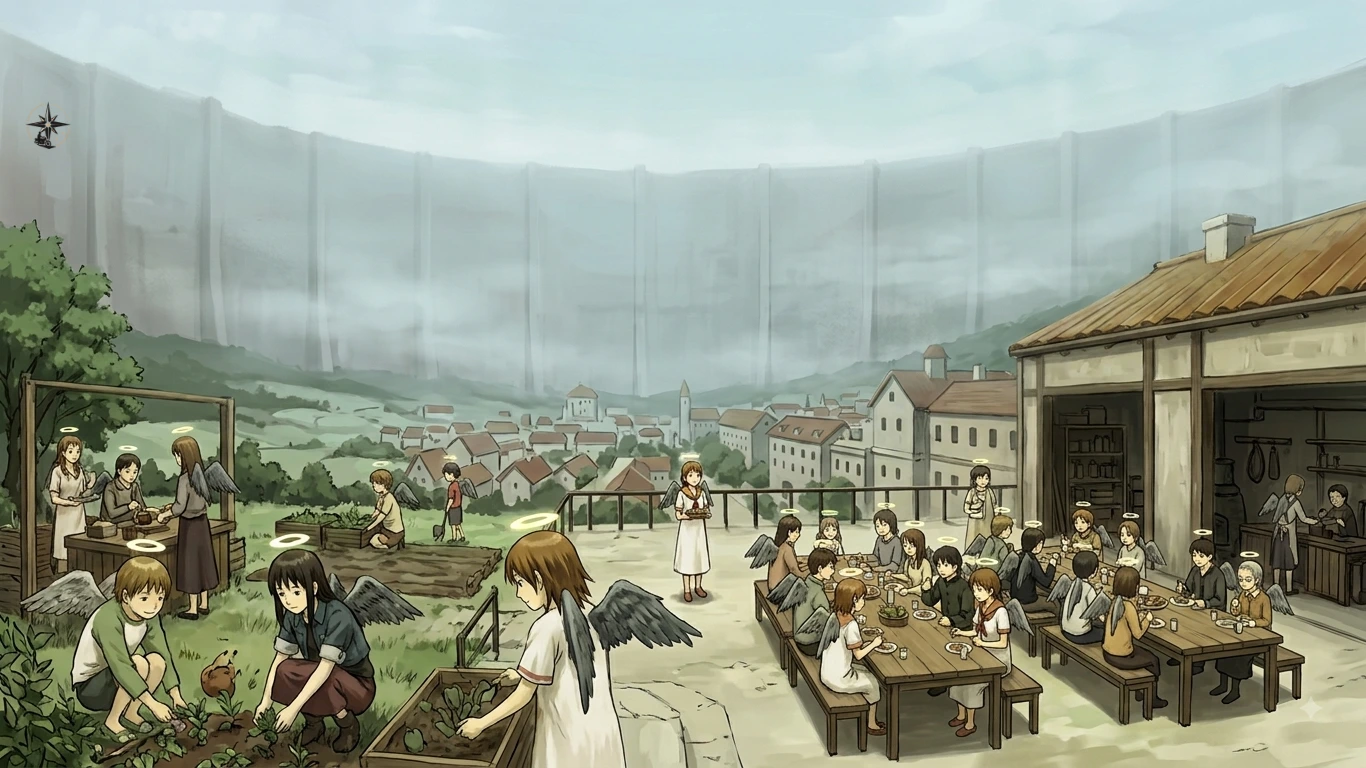
At first glance, Old Home—the weathered residential compound surrounded by the high, impenetrable walls of the town of Glie—resembles a serene slice of countryside life. Young beings with halo-like rings and grey wings hatch from giant cocoons, remembering nothing of their past lives save for a single dream that determines their new name. Yet beneath this gentle slice-of-life exterior lies a stark theological truth. Glie is not a paradise; it is a waiting room for the soul.
The Spatial Theology of Glie
In Western literary traditions, purgatory is often depicted through Dantean imagery: steep mountains, purifying fires, and the arduous climb of self-punishment. Haibane Renmei completely reimages this dynamic by stripping away suffering and replacing it with communal belonging.
The town of Glie is strictly bounded. The Haibane cannot touch the outer walls, nor can they possess money or own new goods; they exist entirely within a circle of recycled items, donated labor, and quiet routines. This isolation is not punitive—it is protective. By removing the anxieties of modern consumerism, social status, and individual ambition, the town creates a sterile, gentle vacuum where the noise of the world is silenced.
+-------------------------------------------------------+
|                     THE TOWN OF GLIE                  |
|                                                       |
|   [ Old Home ] <---> [ Daily Labor ] <---> [ Town ]   |
|         |                                    |        |
|         +------------( The Walls )-----------+        |
|                            |                          |
|                  [ The Unseen Outside ]               |
+-------------------------------------------------------+
In this enclosed space, healing is not an individual pursuit performed in isolation. To live as a Haibane is to serve the town and rely on one’s peers. Purgatory is reframed not as a place where one suffers for past sins, but as a space where one learns how to accept help.
The Anatomy of the Sin-Bound
The psychological core of the series lies in the distinction between those who can accept their condition and those who remain sin-bound (Tsumi-tsuki). When a Haibane is unable to recall their cocoon dream or remains trapped in the subconscious trauma of how they died, their wings sprout black feathers—a physical manifestation of unexpressed guilt and self-loathing.
“To be bound by sin is to believe that you are beyond forgiveness, and that to seek help is to burden others.”
Rakka’s descent into depression following the departure of Kuramori, and Rekka’s (Reki) decades-long struggle with her dark wings, showcase two sides of the same spiritual crisis:
- Rakka’s Crisis: A sudden loss of meaning leading to spatial and emotional isolation (falling into the well).
- Reki’s Crisis: A chronic, performative martyrdom where she acts as the maternal caretaker for everyone else to avoid confronting her own internal void.
Reki’s tragedy is particularly poignant. She attempts to manufacture her own salvation through good deeds and artistic creation, believing she can earn her halo through self-reliance. But Haibane Renmei insists on a radical premise: no one can cleanse their own wings. Salvation cannot be earned through works alone; it requires the vulnerability of letting someone else see your darkest, unwashed self and love you anyway.
The Day of Flight: Grace Without Guarantees
When a Haibane’s time in Glie finishes, they undergo the Day of Flight—passing over the forest walls into the unknown. They leave behind their halos and clothes, taking nothing with them.
What makes ABe’s vision so profoundly moving is its refusal to offer easy answers about what lies beyond the wall. We never learn what the Haibane were before, nor do we see where they go after. The focus remains entirely on the transformational power of the present moment and the community that held them while they healed.
Through its quiet pacing, rust-colored landscapes, and delicate acoustic score, Haibane Renmei offers a comforting thesis for anyone who has ever felt stranded in their own life: our intermediate states—our purgatories—are not wasted time. They are the necessary soils where, supported by the quiet kindness of others, we finally learn how to let go.