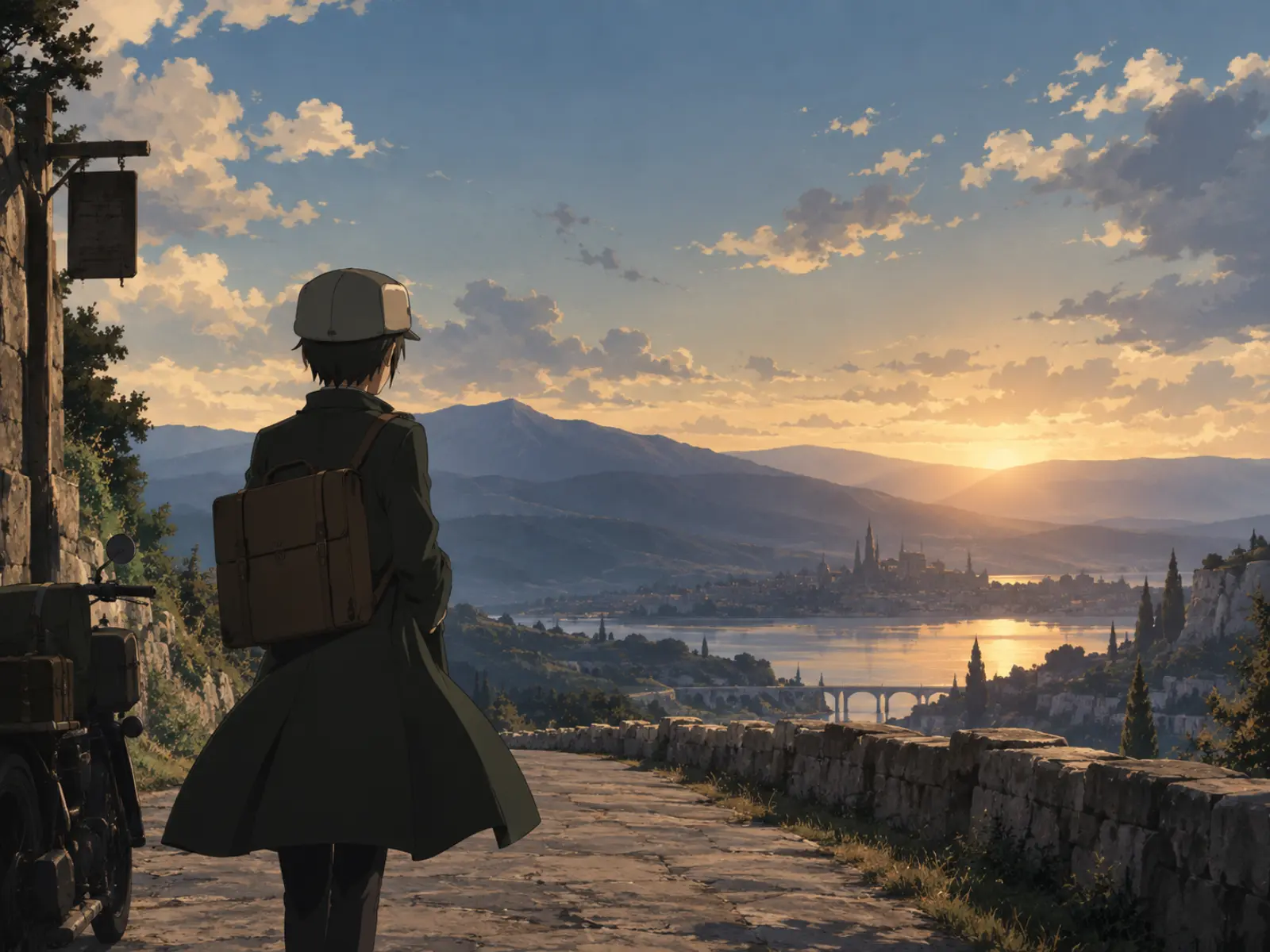
In the realm of anime, freedom is rarely a quiet affair. We are conditioned to view liberation through the lens of escape: the protagonist breaks their chains, shatters the dome of a walled city, or runs away from home to pursue their destiny. Freedom is often depicted as the absence of boundaries, the triumph of the individual over the oppressive forces of society. We cheer for the wanderer who leaves everything behind. But what if true freedom is not found in the escape? What if it is found in the deliberate choice to stay?
This is the unexpected philosophical territory explored in Shikimori’s Not Just a Cutie (Kawaii dake ja Nai Shikimori-san). Beneath its pastel-colored exterior and romantic comedy tropes, the series quietly dismantles our traditional understanding of what it means to be free. It suggests that freedom is not the avoidance of vulnerability or the isolation of total independence. Rather, freedom in anime is rarely about escape — it is about the quiet choice to stay, to return, and to belong.
The Illusion of Independence
To understand the freedom presented in Shikimori, we must first look at its foil: the protagonist, Izumi. Izumi is the ultimate victim of circumstance. His life is governed by a relentless streak of bad luck. He loses his belongings, trips over nothing, and constantly finds himself on the brink of disaster. In a traditional narrative, Izumi’s journey to freedom would involve him toughening up, learning to survive entirely on his own, and mastering his chaotic environment.
But Izumi cannot master his environment. The universe is simply too chaotic, a truth that mirrors the human condition. We are all, to some extent, at the mercy of unpredictable forces—illness, economic shifts, accidents, and grief. The illusion of absolute independence is just that: an illusion. If freedom is defined as total self-sufficiency, then human beings are fundamentally condemned to be unfree. Shikimori rejects this premise. It posits that if we cannot control the chaos around us, perhaps true freedom lies in how we choose to navigate it, and who we choose to navigate it with.
Shikimori’s Agency: The Freedom to Protect
Miyako Shikimori represents a fascinating subversion of anime tropes. She is fiercely capable, athletic, and cool under pressure. Yet, her strength is not used to conquer the world; it is used to shield the person she loves. Some might argue that attaching oneself to a perpetually unlucky partner is the opposite of freedom—a self-imposed burden. But this misses the profound agency inherent in Shikimori’s character.
Shikimori does not protect Izumi out of obligation or societal pressure. She does it out of a deliberate, conscious choice. In existential philosophy, the highest form of freedom is the ability to define one’s own essence through action. Shikimori defines herself through her choice to be Izumi’s protector. Her strength is not a cage that keeps her bound to his mishaps; it is the tool she uses to carve out a safe space in an inherently unsafe world. She is free precisely because she has chosen her purpose, and she acts on it without hesitation.
Izumi’s Acceptance: Freedom from the Burden of Perfection
If Shikimori’s freedom lies in her agency, Izumi’s freedom is found in his radical acceptance of vulnerability. In a society that equates masculinity with invulnerability, Izumi’s constant need for rescue could easily be framed as a failure. He is not the knight in shining armor; he is the one constantly being saved.
Yet, there is a profound liberation in Izumi’s character. He does not stubbornly reject help to protect his pride, nor does he resent Shikimori for her competence. He embraces his vulnerability and accepts her support gracefully. This requires an immense amount of emotional courage.
To admit that we cannot do it all alone—to allow ourselves to be seen in our weakness—is to break free from the exhausting performance of perfection. Izumi is free from the pressure of having to be the savior. He is allowed to simply exist, flaws and all, secure in the knowledge that he is loved not for his capability, but for his character. His warmth, kindness, and unwavering appreciation for Shikimori are his own quiet forms of strength.
The Quiet Rebellion of Staying
The central thesis of Shikimori’s Not Just a Cutie is a quiet rebellion against the modern obsession with infinite, boundless freedom. We often treat commitment as a loss of freedom, a locking away of one’s potential. But the series suggests that commitment is the canvas upon which true freedom is painted.
Consider the alternative. A life of perpetual escape, where one never commits to a person or a place, is often a life governed by fear—fear of loss, fear of disappointment, fear of vulnerability. It is easy to be “free” when you have nothing to lose. But to choose to stay, to invest deeply in another person despite the certainty of future hardships, requires a different kind of courage.
When Shikimori catches Izumi as he falls, she is not restricting his freedom; she is offering him a safe harbor from which he can explore the world. When Izumi encourages Shikimori in her endeavors, he is not holding her back; he is giving her the emotional foundation to take risks. Their relationship is a mutual exchange of freedom. They liberate each other from the terrifying isolation of facing the world alone.
Love as a Voluntary Cage
The philosopher Jean-Paul Sartre famously argued that we are “condemned to be free,” burdened by the terrifying weight of infinite choices. In many ways, love is the antidote to this existential vertigo. By choosing to love someone, we voluntarily narrow our infinite choices. We draw a boundary around ourselves. From the outside, this boundary looks like a cage. But from the inside, it is a sanctuary.
Shikimori and Izumi have built a voluntary cage. They have chosen each other, with all the messy, unlucky, chaotic reality that entails. And within that boundary, they find a profound sense of peace. The outside world still throws its curveballs—Izumi still trips, disasters still strike—but the foundation of their relationship remains unshaken. This is their freedom: not the absence of chaos, but the presence of an unwavering anchor in the midst of it.
Conclusion: The Courage to Return
Ultimately, Shikimori teaches us that freedom is not merely about the ability to leave; it is about the power to return. It is the realization that the highest expression of human agency is not found in isolation, but in connection. To be free is to look at the chaotic, unpredictable world, and then to look at the person beside you, and say, “I choose to stay here, with you.”
In a genre often dominated by grand escapes and solitary wanderers, the story of Shikimori and Izumi stands as a gentle reminder. True freedom is not the absence of burdens. It is the privilege of choosing which burdens are worth carrying.