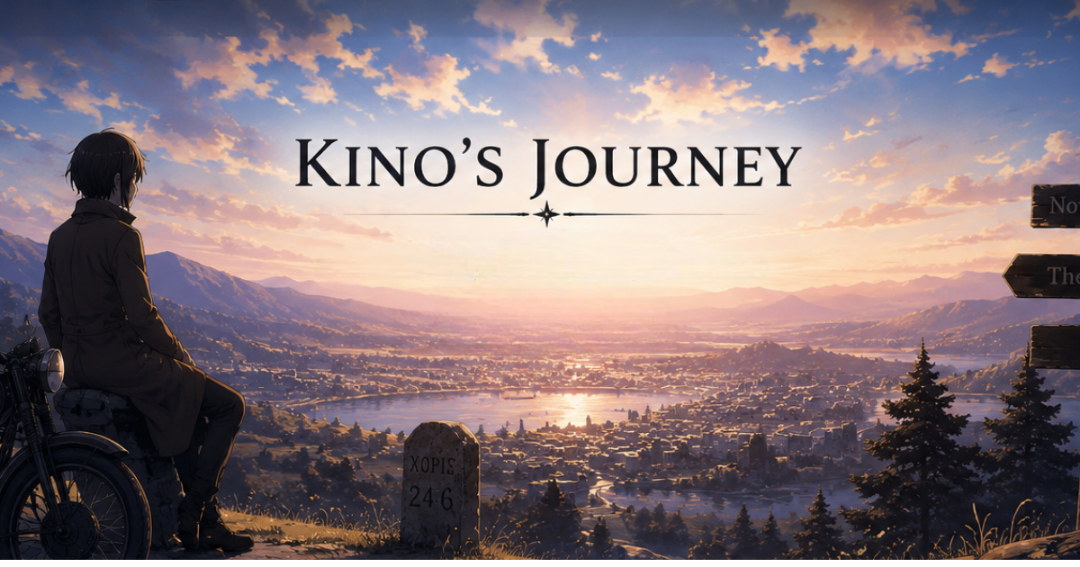
“The world is not beautiful; therefore, it is.” This paradox is the philosophical heartbeat of Kino’s Journey. For over two decades, fans have debated the meaning of this phrase. It is not a statement of pessimism, nor is it a naive attempt to find silver linings in tragedy. Rather, it is an acknowledgment that the world’s beauty is inextricably linked to its unpredictability. The world is beautiful because it is filled with unknowns.
In Kino’s Journey, travel is not merely a physical act of moving from point A to point B. It is a philosophical lens. Every country Kino visits is a new question, and every departure is a quiet surrender to uncertainty. By stripping away the desire for final answers, the series offers a profound meditation on how to live with the mysteries of existence.
The Epistemology of the Journey: Every Country is a Question
Epistemology—the study of knowledge and how we acquire it—is at the core of Kino’s journey. Most traditional narratives are built on the premise of discovery: the hero ventures out to solve a mystery, defeat a villain, or find a truth. The audience expects closure. Kino’s Journey actively subverts this expectation.
When Kino and Hermes arrive at the gates of a new walled city, they do not enter with a hypothesis. They enter as blank slates. The customs, laws, and traditions they encounter are often bizarre, cruel, or wonderfully utopian. But Kino does not seek to categorize these societies into neat boxes of “right” and “wrong.” Each country functions as a thought experiment posed to the universe.
In one land, Kino might ask, “What happens when a society outlaws murder but institutionalizes execution?” In another, “Can a civilization survive if it perfectly predicts the future?” The series treats these scenarios not as problems to be solved, but as realities to be witnessed. The journey is an admission that absolute knowledge of the human condition is impossible. By accepting that every country is just a question, Kino embraces the unknown as the primary engine of thought.
The Anxiety of the Unknown vs. The Joy of Discovery
Human beings are biologically wired to fear the unknown. Uncertainty triggers anxiety; it signals a potential threat. To combat this, human societies build structures: routines, laws, religions, and traditions. We construct walls—both literal and metaphorical—to keep the unpredictable at bay.
Throughout Kino’s Journey, we see the extreme lengths societies will go to eliminate uncertainty. We see countries that have sacrificed freedom for absolute safety, or citizens who have given up their individuality to ensure a predictable, harmonious existence. These societies are often stagnant, having traded the joy of discovery for the comfort of certainty.
Kino represents the antithesis of this human anxiety. To travel constantly is to willingly step back into the unknown every single day. The joy of discovery in Kino’s Journey does not come from finding a perfect utopia, but from the sheer act of encountering the unfamiliar. Kino finds beauty in the bizarre, the tragic, and the incomprehensible because these elements represent the unbridled, untamed nature of life. The unknown is not a threat to be eradicated; it is the very condition that makes life worth experiencing.
The Departure as a Philosophical Act
Just as important as Kino’s arrival is Kino’s departure. The Three-Day Rule dictates that the traveler must leave before becoming a permanent part of the landscape. This departure is a quiet surrender to uncertainty. If Kino were to stay, the unknown would eventually become the known. The questions would harden into dogma.
By leaving on the third day, Kino preserves the mystery. The traveler refuses the temptation of permanence. There is a profound philosophical strength in this act of letting go. It is an acknowledgment that to hold onto something too tightly is to crush it, to strip it of its natural vitality. The departure is a refusal to impose finality on a world that is inherently fluid.
This constant motion is a form of existential surrender. Kino does not know what lies over the next hill, whether the next country will be welcoming or hostile, or what the weather will bring. And yet, the engine starts, and the journey continues. The beauty of the world, the series argues, can only be appreciated if we are willing to leave the safety of what we know and walk into the fog of what we do not.
Hermes: The Socratic Navigator
It is impossible to discuss the philosophical framework of Kino’s Journey without mentioning Hermes, the talking motorcycle. Hermes is far more than a mode of transportation; he is Kino’s Socratic interlocutor. Through their dialogues, the series processes the unknown.
Hermes frequently points out logical flaws, questions Kino’s observations, or simply asks, “Why?” This dialogue mirrors the Socratic method, where truth is pursued not by lecturing, but by asking a series of probing questions. When the two travelers encounter a baffling custom, their subsequent conversation is an attempt to navigate the uncertainty together.
Crucially, Hermes rarely provides the audience with a neat conclusion. His questions often go unanswered, or Kino’s replies are intentionally ambiguous. This dynamic reinforces the show’s core philosophy: the value lies in the act of questioning, not in the illusion of a definitive answer. Hermes serves as a reminder that we do not travel to conquer the unknown, but to converse with it.
Finding Peace in the Unmapped
Ultimately, Kino’s Journey argues that the world’s ugliness—its cruelty, its suffering, its chaos—is the very thing that gives it texture. If the world were perfectly mapped, perfectly understood, and perfectly safe, it would be stagnant. It would be a museum exhibit rather than a living, breathing ecosystem.
The beauty of the world is found in its unmapped territories. It is found in the strange traditions of isolated countries, in the unexpected kindness of strangers, and in the quiet moments of reflection by a campfire under a sky full of stars. It is found in the realization that no matter how much we travel, there will always be another horizon, another question, another mystery waiting just beyond the city walls.
The world is not beautiful despite being filled with unknowns. It is beautiful because it is filled with unknowns. And in a quiet surrender to that uncertainty, the traveler finds peace.
Disclaimer: Kino’s Journey is a trademark of Kadokawa Corporation. This is an independent, unofficial fan blog and is not affiliated with the original creators. Historically, this domain was the official website for the 2003 anime release by ADV Films. That company is no longer active, and I legally acquired the expired domain as a private individual. Today, this site serves as a modern niche blog dedicated to exploring the philosophy of the series.