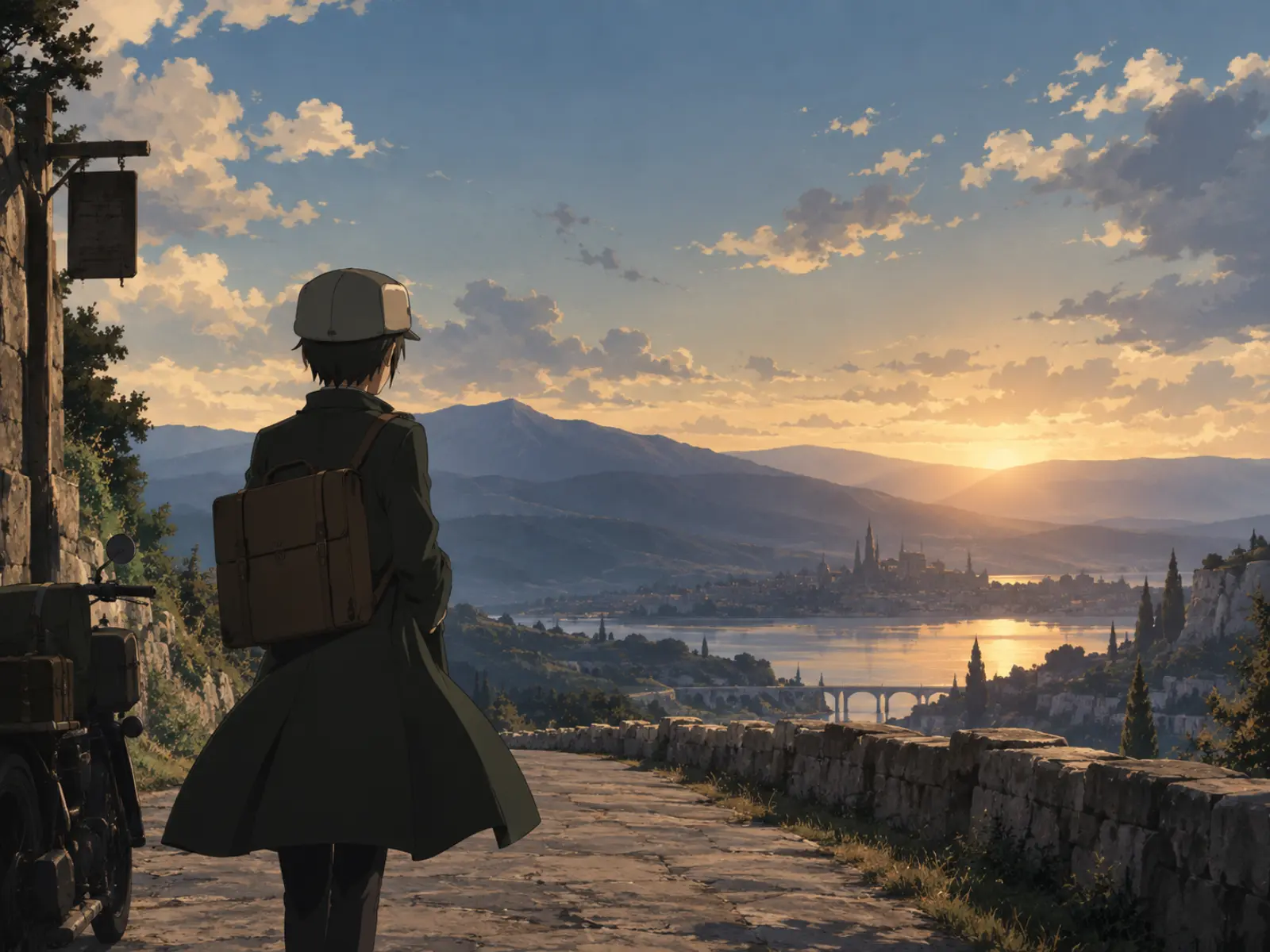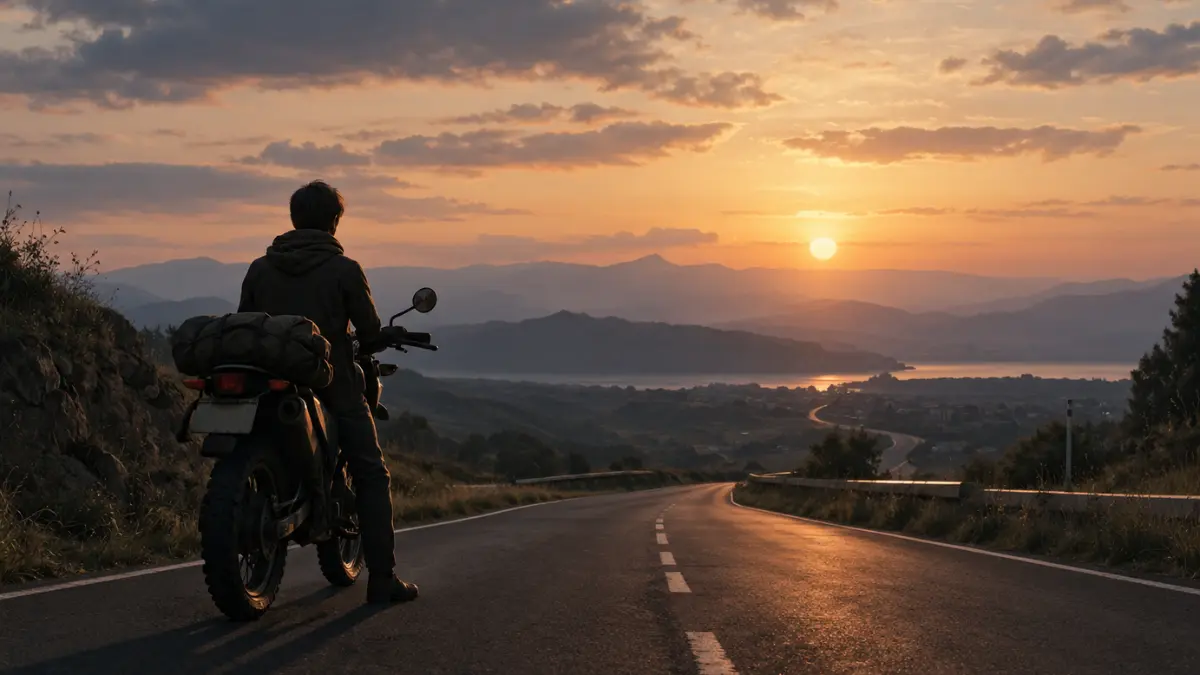
Most stories start with a beginning. Kino’s Journey started with an ending.
Who Is Keiichi Sigsawa?
Keiichi Sigsawa (時雨沢恵一) was born in 1972 in Kanagawa Prefecture, Japan. “Sigsawa” is a pen name — pieced together, by his own account, from SIG Sauer, the firearms manufacturer, and Keiichi Morisato, a character from the manga Oh My Goddess! He describes himself as a self-confessed “gun maniac,” and the influence shows: firearms appear throughout Kino’s Journey with a level of technical precision unusual for the genre.
He is, above all, a motorcyclist. Sigsawa owns several off-road motorcycles and has spoken about dreaming of riding around the world on one. That’s not incidental detail — it’s the origin of the entire series.
The Ending Came First
In a 2017 interview with Anime News Network, Sigsawa said the story came before the character: Kino wasn’t designed and then given a plot — a plot existed, and Kino was placed into it. His favorite story in the series, “A Peaceful Land — Mother’s Love,” was also the very first one he wrote — and it comes at the end of the first novel, because, in his words, he “started near the end and then wrote backwards.” He has said much the same about Hermes, the talking motorcycle: he wanted a traveling companion, and reasoned that a motorcycle could serve that role as easily as a person — so he simply gave it a voice.
That’s a genuinely unusual way to build a series: not a premise expanded outward, but a conclusion worked backward from.
What He Was — and Wasn’t — Drawing On
Kino’s Journey is compared constantly to The Little Prince. But in a 2005 interview, Sigsawa said plainly: he hadn’t read it before writing his own book — only afterward, once people pointed out the resemblance. His stated influences run elsewhere: Galaxy Express 999, and the films of Hayao Miyazaki — both stories about journeys through strange, self-contained worlds, which tracks.
The Afterwords Are Part of the Work
One detail that rarely makes it into English-language coverage: Sigsawa is known almost as much for his afterwords as for his fiction. Where most light novel authors use the space for a brief, perfunctory note, his have included song lyrics, quizzes, and mock interviews with his own editor. One throwaway joke in a volume-four afterword — “Kino turns into a school student and shenanigans ensue” — became its own spin-off series, Gakuen Kino. It’s a small window into a writer who treats even the margins of the page as material.
A Career Built Around Kino, Not Defined by It
Sigsawa has written steadily since his 2000 debut — Allison, Lillia and Treize, and, more recently, the Sword Art Online Alternative: Gun Gale Online novels, a series he has said he specifically asked to write after being a fan of that corner of the SAO universe. But Kino’s Journey has remained the constant: one volume roughly a year, for over two decades, across 24 volumes and counting.
Understanding that origin — an ending built first, a philosophy assembled backward from it — changes how the series’ central refusal to judge reads. It wasn’t a moral conclusion Sigsawa set out to illustrate. It was there from the very first page he wrote, years before anyone read it.