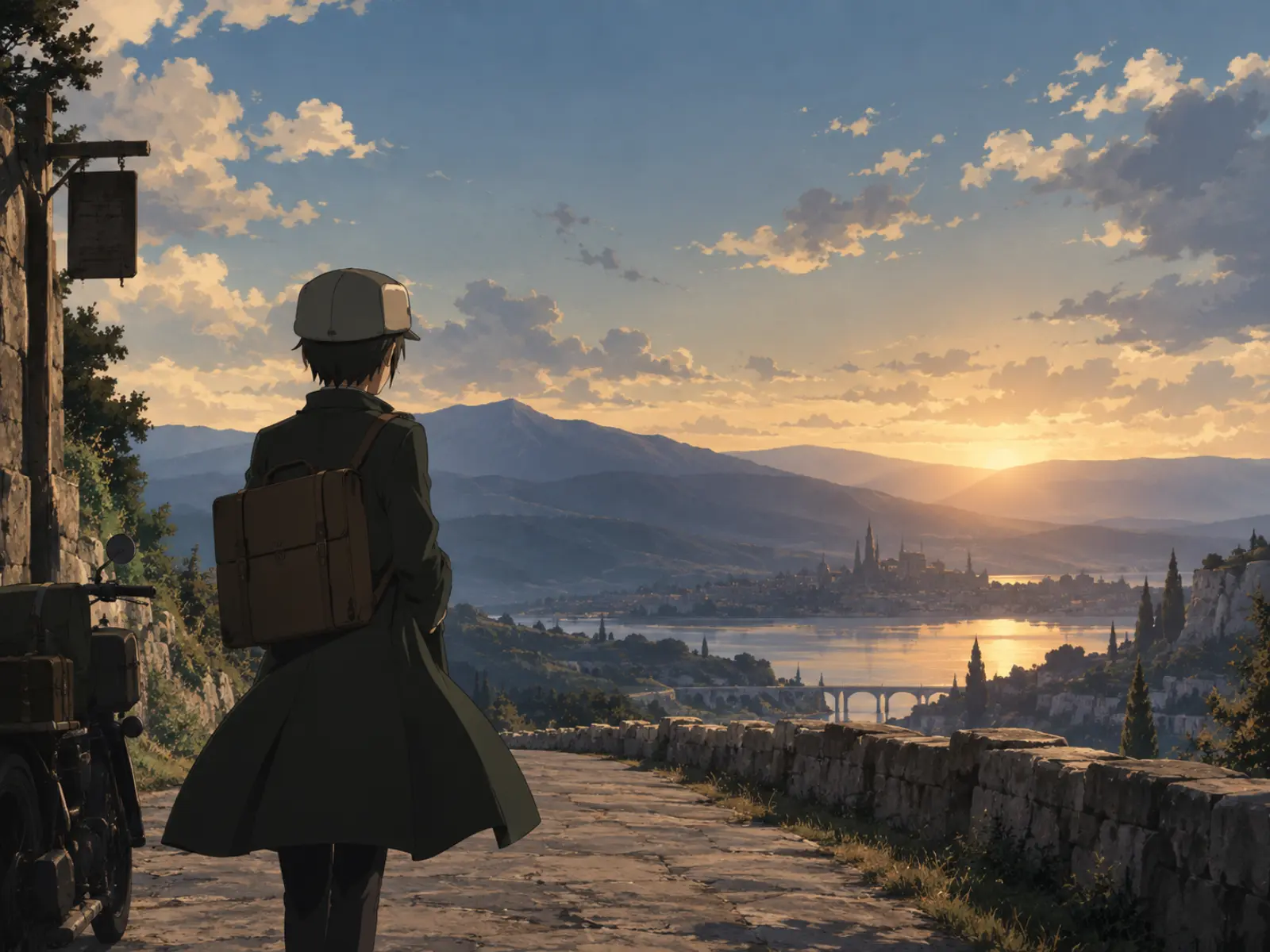
If you’ve searched for the Kino’s Journey light novel English release, you’ve probably come away confused — you’re not imagining things. The situation is genuinely tangled, and most guides online don’t explain why.
The Japanese Original: 24 Volumes and Counting
Keiichi Sigsawa’s light novel began serialization in 2000 and has continued at roughly one volume a year since. As of late 2025, 24 volumes have been published in Japan under ASCII Media Works’ Dengeki Bunko imprint, alongside a parody spin-off series, Gakuen Kino, which reimagines Kino as a magical-girl student.
What Happened to the English Light Novel
Here’s the part most searches don’t turn up clearly: Tokyopop licensed the light novels for English release in 2006 — and published exactly one volume before the deal fell apart. According to the English-language publication’s own history, Tokyopop released volume one under the romanized title Kino no Tabi, rearranged its chapter order, and then canceled the rest of the series over licensing issues. That single 2006 volume is now out of print and difficult to find secondhand.
There has never been a complete official English translation of the original light novel series. If you’ve seen “Kino’s Journey” volumes on a bookstore shelf or Amazon more recently, it almost certainly wasn’t the light novel.
What You’re Actually Seeing: The Manga
Starting in 2019, the publisher Vertical released an eight-volume English edition titled Kino’s Journey: The Beautiful World — but this is a manga adaptation, illustrated by Iruka Shiomiya, not a translation of Sigsawa’s original prose. It adapts the same stories, and reviewers have noted it reorders some early chapters so Kino’s backstory lands earlier than it does in the original volume order — but it’s a different work in a different medium, complete and currently in print.
For most English-speaking readers today, this manga is the most accessible way to experience the source material in something close to its original form.
If You Want the Actual Prose
Fan translation communities have worked through much of the original light novel text over the years — Baka-Tsuki’s long-running project and others have covered a majority of the volumes, in varying states of completion. We won’t link specific unofficial translations here, but they’re easy enough to find if you go looking, with the usual caveat that quality and completeness vary by volume and translator.
So: Where Should You Actually Start?
- New to the story entirely? Start with our complete guide for context, then watch the 2003 anime — still the most faithful adaptation of the early volumes, and the easiest complete version to access legally today.
- Want something in print, in English, close to Sigsawa’s original stories? Vertical’s manga is your best current option.
- Committed to the actual prose, gaps and all? The fan translation community is where that currently lives.
None of this is a satisfying answer for a series this acclaimed — 8.2 million copies sold in Japan, a light novel considered a genre landmark. But an accurate answer is more useful than a confident wrong one, and most guides currently online give the wrong one.