“Philosophical anime” is a crowded search term, and most lists that answer it are interchangeable — the same six titles, reshuffled, with a sentence of praise and nothing about why they’d actually appeal to a specific kind of viewer. If you found your way here because Kino’s Journey got under your skin, here’s a more useful version: five series that share something real with it, and exactly where each one breaks away.
Mushishi (2005–2014)
The similarity: A solitary wanderer moves through self-contained encounters, observing rather than intervening, in a slow, contemplative register that never raises its voice. Ginko, the mushi master, shares Kino’s structural role almost exactly.
The difference: Mushishi is warmer and more resolved. Where Kino often leaves a country’s problem exactly as unsolved as she found it, Ginko frequently restores some kind of balance by episode’s end. This is philosophy through ecology, not through moral confrontation.
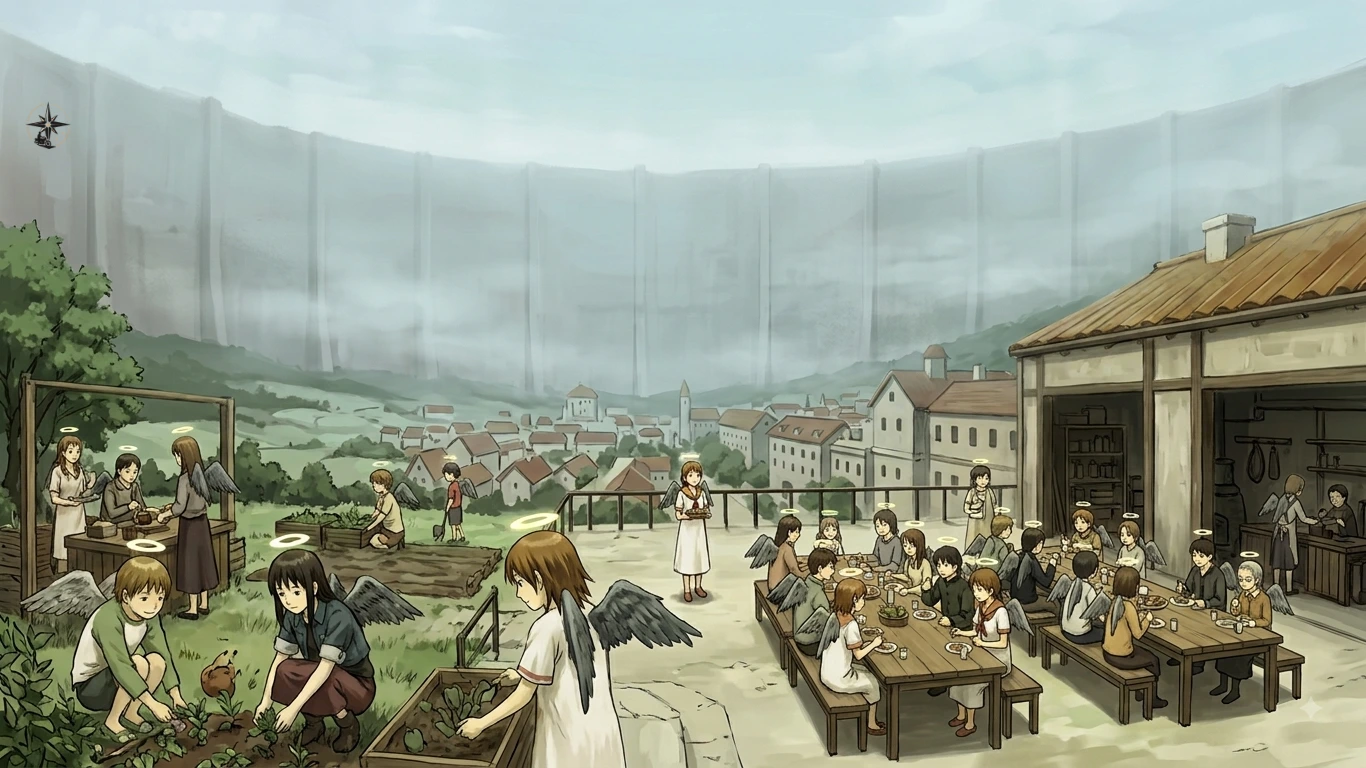
Haibane Renmei (2002)
The similarity: Same quiet, melancholic register, and — not a coincidence — character designer Yoshitoshi ABe brings a visual stillness that rhymes with Kino’s Journey‘s own restraint.
The difference: No travel at all. The entire series happens inside one walled town, and the questions are inward-facing — guilt, memory, what you owe your past self — rather than outward-facing critiques of the societies Kino visits.
Serial Experiments Lain (1998)
The similarity: This one isn’t a stretch — Ryūtarō Nakamura directed both Lain and the 2003 Kino’s Journey anime, five years apart, and the visual patience is recognizably the same hand at work: long silences, static compositions, ambiguity left standing.
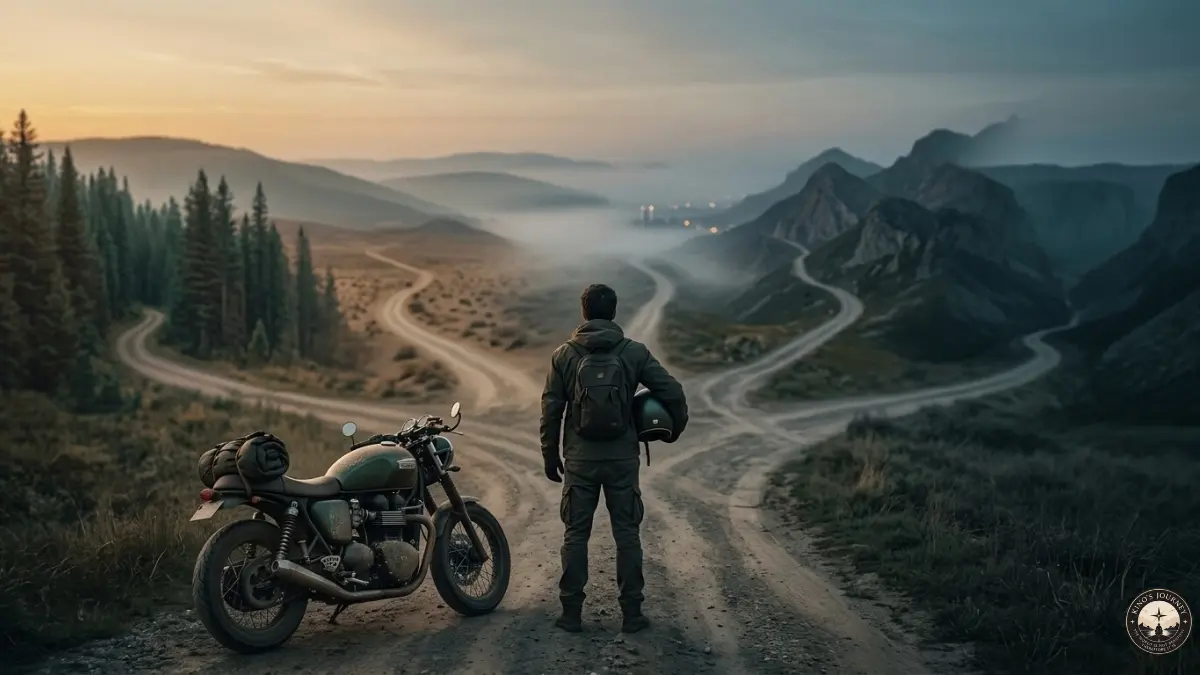
The difference: Lain dissolves outward into cyberpunk reality-collapse — identity, networks, what “real” even means — while Kino’s Journey stays grounded in a road, a motorcycle, and countries you could point to on a map.
Mononoke (2007)
The similarity: Another wandering outsider (the Medicine Seller) moving between self-contained stories, each one built around confronting a human failing rather than a monster.
The difference: Visually, it’s the opposite approach — maximalist, kaleidoscopic, almost overwhelming — where Kino’s Journey is spare. If Kino’s restraint ever starts to feel austere, Mononoke is what the same structural idea looks like turned up to full volume.
Texhnolyze (2003)
The similarity: Sparse dialogue, unflinching philosophical bleakness, a refusal to explain itself or soften its conclusions — this is the closest thing on this list to Kino’s Journey‘s willingness to sit in discomfort without resolving it. It’s also a closer relative than it first appears: Texhnolyze shares half its creative DNA with Lain itself, with writer Chiaki J. Konaka and character designer Yoshitoshi ABe working on both — even without Nakamura in the director’s chair this time.
The difference: Considerably darker and more violent, confined to a single decaying underground city rather than an open road. Where Kino’s Journey is meditative, Texhnolyze is claustrophobic.
Where to Go From Here
If the throughline for you is the refusal to intervene, start with Mushishi. If it’s the visual patience and ambiguity, Lain is the more direct bloodline. If you want the same structure with the volume turned up, Mononoke. And if you’re here for the philosophy specifically, our full breakdown of the ideas running through Kino’s Journey is the place to go deeper on the source itself.