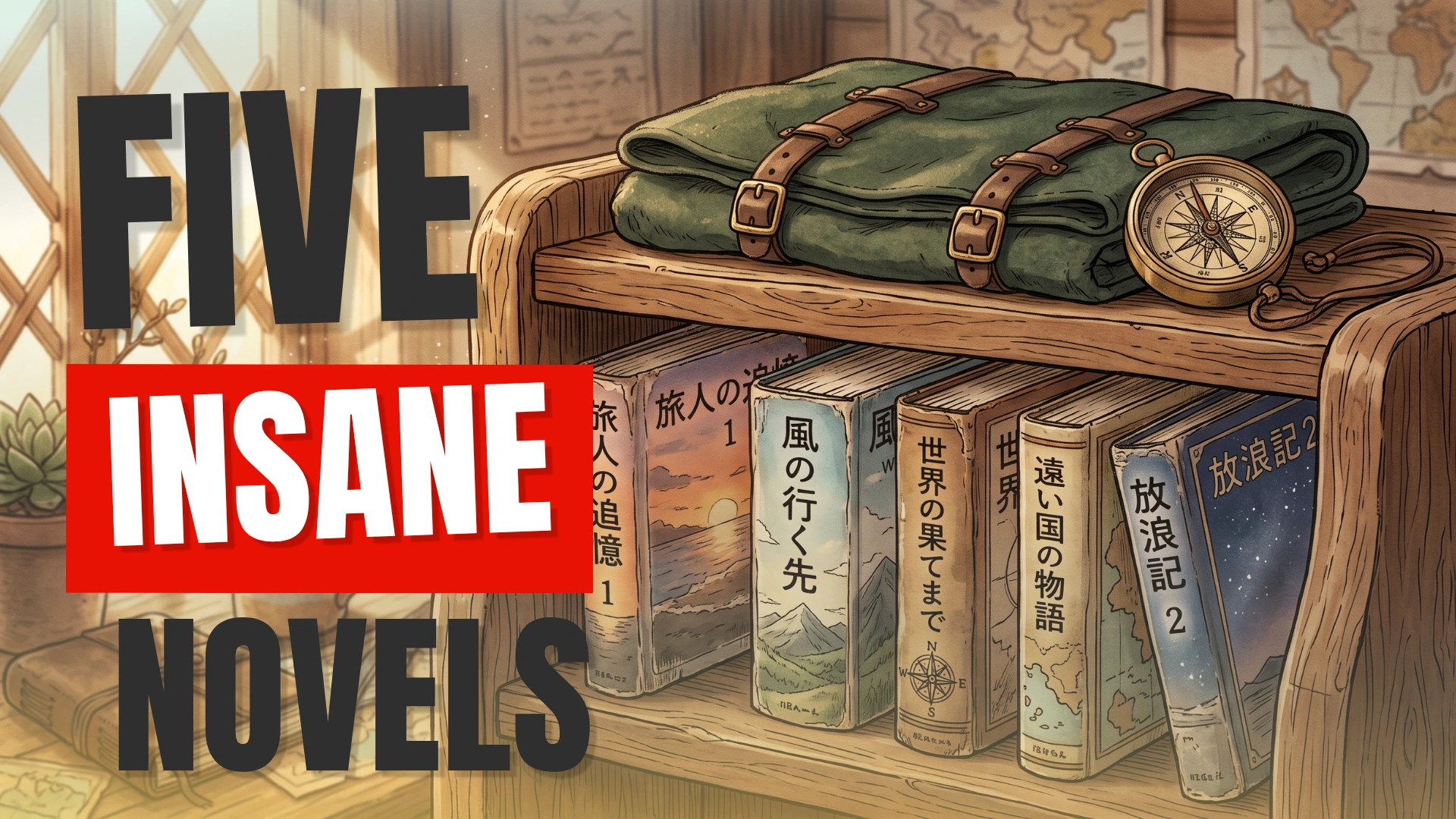
Owning a book you have lived with for a while carries a different weight than simply having watched something on a screen.
Streaming delivers stories efficiently, but a physical volume endures. It sits where you left it, gathers the marks of repeated reading, and sometimes reveals something new when you open it years later without planning to.
For anyone drawn to the reflective, question-driven storytelling of Kino’s Journey, building a shelf around that single series would be understandable — but it would also be a missed opportunity. Other manga and light novels wrestle with the same kinds of concerns: how societies justify themselves, what freedom actually costs, whether identity holds steady or shifts with experience.
These five are worth the shelf space.
1. Kino’s Journey — Keiichi Sigsawa
Starting with the source material itself is hard to argue against.
The anime adaptations capture the tone beautifully, but the original light novels by Keiichi Sigsawa offer something the screen cannot: room to sit with a single episode, reread a passage, and linger on a detail that might have slipped past at playback speed. The self-contained chapter structure suits print particularly well — each story is a discrete visit that you can close the book on and return to whenever you are ready.
If the anime was your way in, the novels are a way to go deeper without changing the landscape.
Why it belongs on the shelf:
Because every other title on this list exists in conversation with the questions Kino’s Journey raises, and the original novels are where those questions begin.
2. Monster — Naoki Urasawa
Naoki Urasawa’s Monster asks philosophical questions through sustained tension rather than quiet observation.
Dr. Kenzo Tenma makes a choice early in the series — saving a child’s life — that unravels across years in ways he never foresaw. What grows from that single decision is a thriller built around the weight of responsibility, the boundaries of morality, and the uneven value the world assigns to human lives.
The overlap with Kino’s Journey is not in tone or pacing but in temperament. Both works are more interested in presenting moral complexity than in resolving it. They trust the reader to sit with discomfort.
Why it belongs on the shelf:
For readers ready to follow those same philosophical impulses into darker and more psychologically demanding territory.
3. Aria — Kozue Amano
Where Kino’s Journey often discovers beauty inside uncertainty, Aria starts from a place of gentleness and asks what meaning lives inside ordinary moments.
On Aqua — a terraformed version of Mars — Akari works toward becoming an undine, one of the professional gondoliers who guide visitors through the city of Neo-Venezia. The series moves at a pace that feels almost radical in its slowness. Its drama rarely comes from conflict. Instead, it builds significance around small things: the quality of afternoon light, a passing conversation, the way a season changes the look of a canal.
The connection to Kino’s Journey may not be immediately obvious, but both series share a conviction that travel — even the most local kind — can reshape how you notice the world.
Why it belongs on the shelf:
For its sustained attention to the texture of daily life, and for proving that philosophical depth does not require darkness.
4. The Ghost in the Shell — Masamune Shirow
Masamune Shirow’s The Ghost in the Shell shifts the philosophical terrain from geography to technology.
The questions here are no longer about where we travel but about what travels with us. If consciousness can be separated from the body, mapped onto machines, duplicated or fragmented — what part of that is still a person? Where does the self actually live when the boundary between flesh and code stops being clear?
The world of Ghost in the Shell shares almost nothing with the quiet, rural landscapes of Kino’s Journey. But the underlying impulse — to ask where identity begins and ends, and whether it survives transformation — connects them.
Why it belongs on the shelf:
For readers who want to press the same questions about identity and selfhood into a future where the answers may be even harder to locate.
5. Land of the Lustrous — Haruko Ichikawa
Land of the Lustrous opens as a visually arresting fantasy about gem-bodied beings who defend their home from celestial attackers.
Beneath that premise, something more gradual and more unsettling takes shape. The further the story moves, the more it concentrates on what happens when the things that defined a person — memory, role, relationships, physical form — begin to erode or shift beyond recognition. Identity in this world is not a fixed point; it is something that fractures, rebuilds, and sometimes fails to reassemble.
The philosophical weight builds slowly, through image and implication rather than exposition. For readers who value ambiguity and unresolved questions, that approach is its own reward.
Why it belongs on the shelf:
For its layered, patient examination of what the self is made of — and what is left when the pieces stop fitting together.
A Library Built Around Questions
A shelf worth building is not necessarily the one that holds the most expensive editions or the titles everyone else is collecting.
It is the one that holds the works that slowed you down — the ones that made you pause, reread a line, or sit with a question you could not answer right away.
Kino’s Journey does that. The four series above do it in different ways, from different angles, and with different tones. But each one offers something to a reader who values observation over certainty.
And that is a more honest reason to own a book than because it appeared on a best-of list.