Table of Contents
Exploring the Kino’s Journey minimalist travel philosophy reveals how a 2003 anime perfectly predicted the hyper-connected, fast-paced world of 2026. In our hyper-connected, fast-paced world, a new generation of connected travelers has emerged. For vloggers and content creators, speed travel is gaining popularity: they combine low-cost flights, spend just three days in a new country, immerse themselves in its culture, and then move on to another destination. This frantic approach to travel might seem chaotic, even superficial, to those unfamiliar with it. However, for fans of the popular early 2000s animated series, this modern trend in vlogging evokes a feeling reminiscent of Keno’s journey.
It is the embodiment of the “Three-Day Rule.”
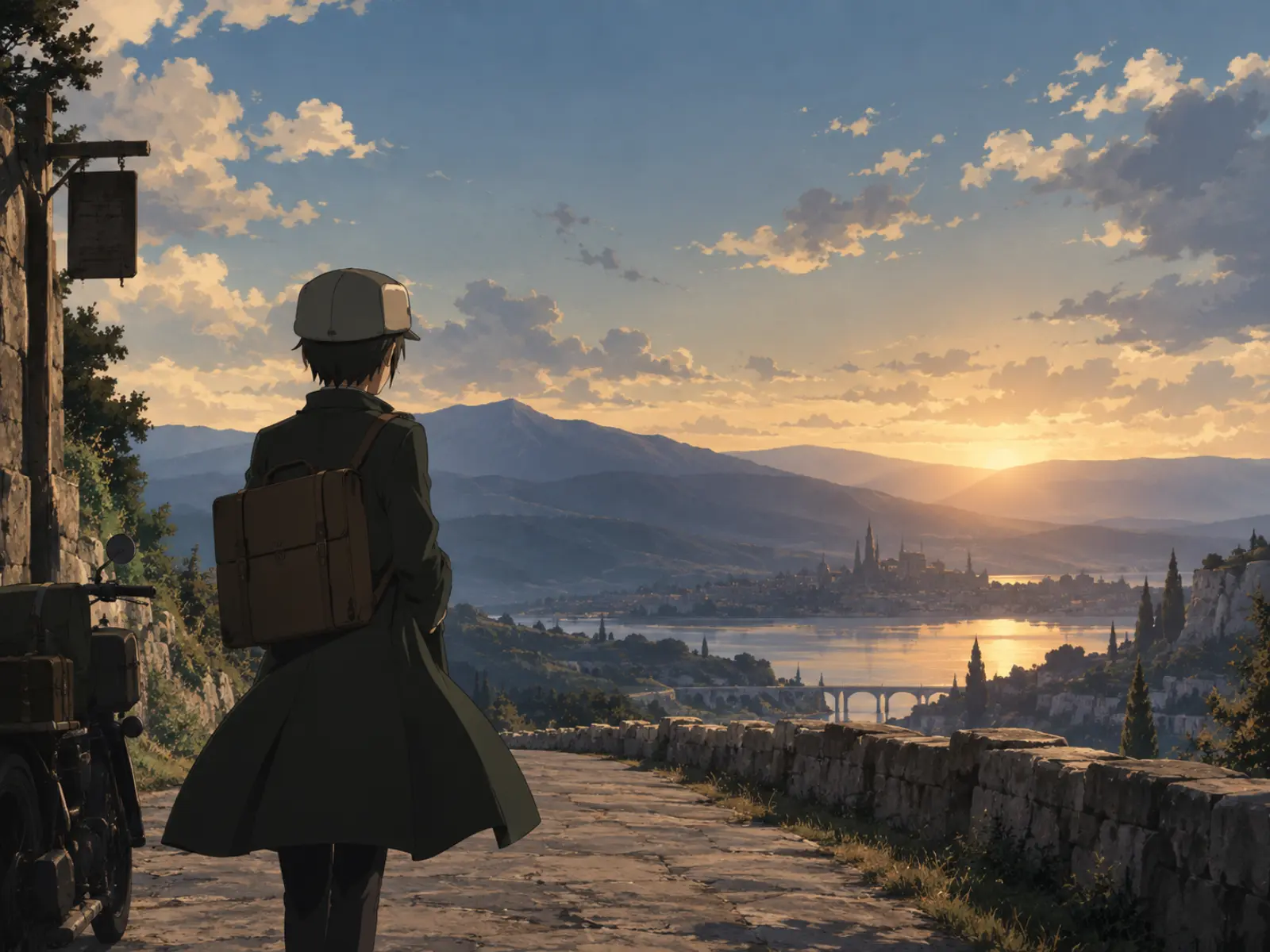
Kino’s Journey (Kino no Tabi) is a profoundly philosophical series that follows a traveler named Kino and their talking motorcycle, Hermes, as they roam a fantastical world of distinct, isolated countries. Kino’s cardinal rule is simple: stay in any single country for no more than three days. Two days are too short to understand the culture, but four days risk assimilation, complacency, or interference. As we look at the modern landscape of minimalist travel and rapid digital nomadism in 2026, Kino’s ancient anime philosophy offers a surprisingly practical blueprint for exploring the real world.
Here is how the ethos of the legendary traveler can inspire—and elevate—your modern minimalist travel experience.
The 2026 Vlogging Trend and the “Three-Day Rule”
Why are so many modern travelers adopting the 72-hour city-hopping model? In 2026, remote work is ubiquitous, and the gig economy has birthed the “content traveler.” These creators pride themselves on efficiency, experiencing as much of the world as possible without being anchored to a single location.
However, rapid travel often leads to burnout, sensory overload, and a nagging feeling that one is merely skimming the surface of a destination. This is where Kino’s philosophy intervenes. Kino does not rush through countries out of a desire to “collect” passport stamps. The Three-Day Rule is a deliberate exercise in impermanence and observation.
By imposing a strict time limit, the modern traveler is forced to be intensely present. When you know you only have 72 hours, you do not procrastinate exploring the local markets. You do not put off visiting the historical sites. More importantly, you do not overstay your welcome. Today’s contemporary video bloggers, who can draw inspiration from Keno, can view their three-day trip not as a race to see everything, but as a carefully selected and deeply focused window of observation.. You cannot see the whole country, but you can deeply understand a single city block if you pay attention.
The Philosophy of Packing Light: What Kino Teaches Us
To embrace Kino’s Journey minimalist travel habits, you must reject the contemporary traveler’s worst enemy: the 50-pound checked suitcase, If there is one visual iconography synonymous with Kino, it is the traveler’s heavily loaded, yet fundamentally compact, setup. Kino carries only the absolute essentials: a sleeping bag, rations, a raincoat, tools, and a persuader (the series’ term for a firearm, which we can metaphorically translate to modern travel safety gear). Every item serves multiple purposes. There is no room for luxury, and there is no room for excess weight.
Modern minimalist travel is built on this exact premise. The contemporary traveler’s worst enemy is the 50-pound checked suitcase. Dragging heavy luggage through cobblestone streets, up narrow apartment staircases, and onto crowded trains saps the joy of the journey.
To travel like Kino is to embrace the freedom of a single carry-on. When you strip away the excess—eliminating the “just-in-case” outfits and the heavy, single-use gadgets—you are left with pure mobility. You can change your plans at a moment’s notice, catch a last-minute train, or walk five miles to a hidden vista without being weighed down by material possessions. Minimalist packing is not just a packing method; it is a declaration of independence from consumerist baggage.
The Modern Wanderer’s Essential Kit
To achieve this level of kinetic freedom, the gear you choose is paramount. Just as Kino maintains Hermes meticulously, the modern traveler must invest in high-quality, utilitarian gear that will survive the friction of the road.
(Note: The following recommendations align with the gear a modern minimalist traveler should consider).
1. The Carry-On Travel Backpack (The Modern “Hermes”)
Your backpack is your companion, much like Hermes. It needs to be durable, comfortable, and strictly sized to meet airline carry-on requirements. Look for a 35L to 45L backpack that opens like a suitcase (clamshell design) for easy packing. It should have a robust harness system to distribute weight evenly across your shoulders, allowing you to walk for hours.
2. The Observer’s Journal
Kino frequently reflects on the nature of the world, finding beauty in its inherent ugliness and danger. In 2026, we are constantly bombarded by notifications and digital noise. To truly observe a new place, you must occasionally disconnect. A lightweight, durable travel journal is essential for recording thoughts, sketching architecture, or logging the names of local dishes. Writing by hand forces you to slow down and process your surroundings in a way that a smartphone camera cannot.
3. Layered, Versatile Clothing
Kino’s iconic black jacket and wide-brimmed hat are a uniform. The beauty of a travel uniform is the elimination of decision fatigue. Modern minimalist travel requires clothing that is moisture-wicking, quick-drying, and modular. Merino wool t-shirts can be worn for days without retaining odor. A lightweight, packable rain jacket protects against sudden weather shifts without taking up half your bag.
4. The Multi-Tool (The Modern “Persuader”)
While we don’t carry firearms for self-defense in the modern travel context (TSA and international laws strictly forbid it), the spirit of being prepared remains. A high-quality travel multitool allows you to open cans, tighten a loose screw on your suitcase, cut a piece of cord, or open a bottle of local wine. It is the ultimate symbol of self-reliance on the road.
The Observer’s Mindset: Detachment in a Hyper-Connected World
Perhaps the most profound lesson Kino’s Journey offers the modern traveler is philosophical: the role of the observer. Throughout the series, Kino encounters countries with bizarre, cruel, or beautiful customs. Sometimes the customs are oppressive; sometimes they are utopian. Yet, Kino almost never intervenes. Kino does not play the hero, does not try to overthrow the government, and does not lecture the locals on how to live.
In our modern era of “voluntourism” and the “savior complex,” where western travelers often arrive in developing nations with the intent to “fix” the local culture, Kino’s stoicism is a breath of fresh air.
When you travel for only three days, you do not have the time or the context to understand the deep, historical nuances of a region’s social issues. The most respectful thing a traveler can do is observe, learn, and leave without causing disruption. This applies to modern vloggers as well: capturing the story of a place is beautiful, but inserting one’s own bias and judgment into a culture you barely understand is a violation of the traveler’s code.
Cultural relativism—the idea that a person’s beliefs and practices should be understood based on that person’s own culture—was practically invented by Kino. By adopting this mindset, the modern traveler sheds the anxiety of “fixing” the world and instead embraces the quiet joy of merely witnessing it.
The Journey is the Destination
As the vlogging trends of 2026 push more travelers into rapid, multi-country expeditions, the risk of burnout is high. But it doesn’t have to be. By adopting the philosophy of Kino, the modern traveler can transform a grueling, three-day sprint across Europe or Asia into a deeply meaningful meditation on impermanence.
Pack light. Carry only what you need. Observe without judgment. Stay long enough to understand, but leave before you become a burden.
The world is not beautiful; therefore, it is. It is up to the traveler to find the beauty in the imperfection, the chaos, and the brief, fleeting encounters that define life on the road. Whether you are riding a talking motorcycle through a fictional desert or catching a bullet train to your next vlog location, the rules of the journey remain the same. By adopting the Kino’s Journey minimalist travel philosophy of Kino, the modern traveler can transform a grueling, three-day sprint across Europe or Asia into a deeply meaningful meditation on impermanence.