


What Is Kino’s Journey?
Some stories are driven by epic battles, dramatic romances, or the fate of entire worlds. Kino’s Journey chooses a quieter path. It tells the story of a traveler who moves from one country to another, observing different societies, customs, and beliefs without trying to change them.
Originally based on the light novel series written by Keiichi Sigsawa, Kino’s Journey has become one of the most respected philosophical works in anime. Rather than following a single continuous plot, each episode introduces a new destination, allowing the series to explore a different moral question or aspect of human nature.
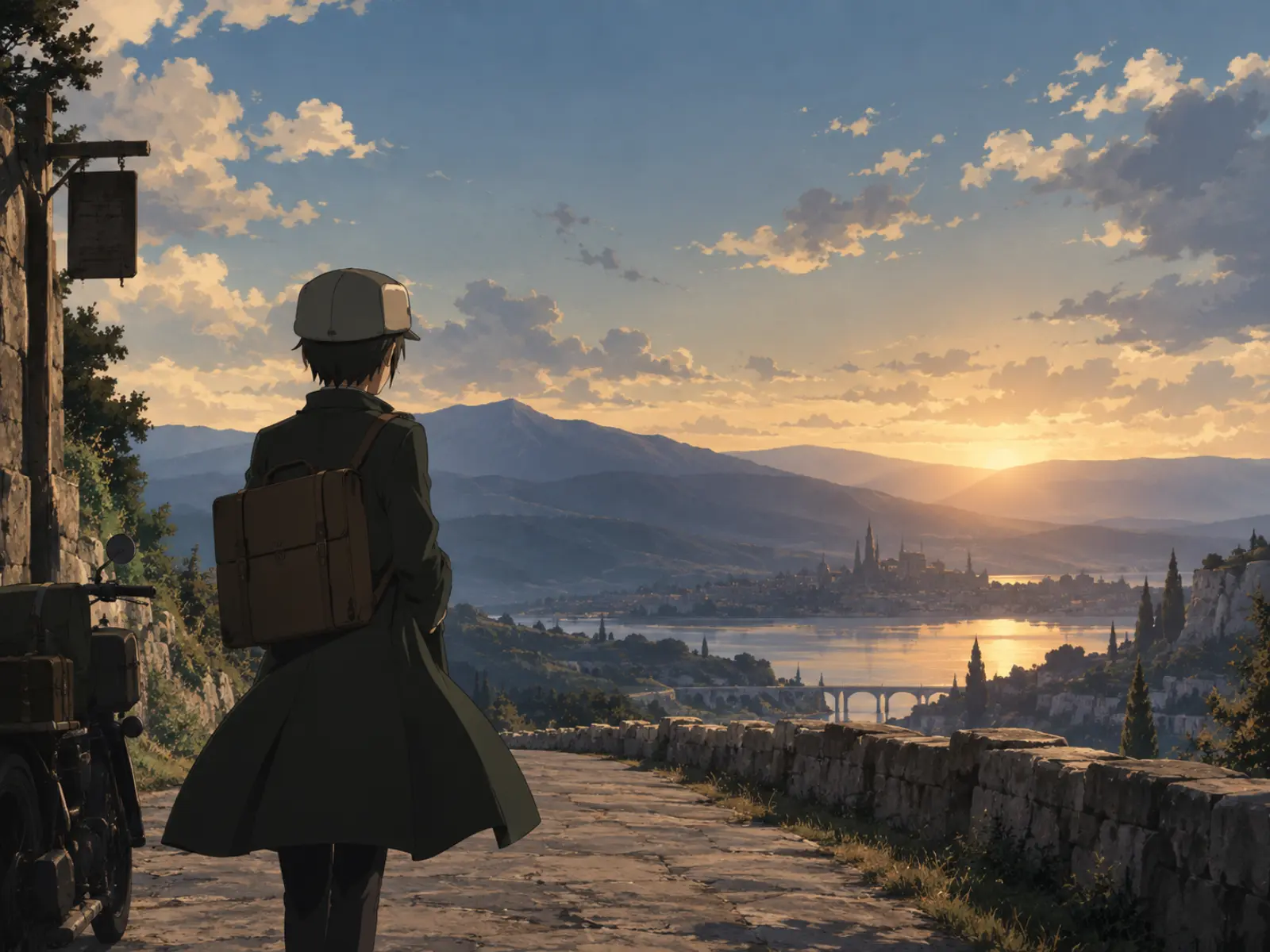
At the center of the story is Kino, a traveler accompanied by a talking motorcycle named Hermes.
Together, they follow one simple rule: stay in each country for only three days before continuing the journey. That limitation gives every visit a sense of curiosity and impermanence, encouraging both the characters and the audience to observe rather than judge.
What makes the series memorable is not its action or spectacle, but its willingness to ask difficult questions without insisting on definitive answers. Every destination presents a different perspective on justice, freedom, identity, tradition, or happiness. Instead of telling viewers what to think, Kino’s Journey invites them to reflect and reach their own conclusions.
More than twenty years after its first anime adaptation, the series continues to attract readers and viewers who appreciate thoughtful storytelling, understated world-building, and stories that linger long after the credits roll.
Quick Fact Kino’s Journey began as a light novel by Keiichi Sigsawa before receiving two separate television anime adaptations, in 2003 and 2017.
The Story (Spoiler-Free)
One of the reasons Kino’s Journey has remained relevant for so many years is that it tells a story unlike most anime. Instead of building toward a single climactic battle or following a traditional hero’s journey, it unfolds as a collection of self-contained travels, each offering a different perspective on the world.
Every episode begins with Kino arriving in a new country. Some places appear peaceful on the surface but hide unsettling traditions beneath them.
Others seem strange or even frightening at first, only to reveal unexpected kindness. By limiting each visit to three days, the series allows viewers to experience each society without fully explaining it, much like a real traveler passing through an unfamiliar land.
This episodic structure means there is no single villain to defeat and no ultimate destination waiting at the end of the road. Instead, the journey itself becomes the story. Every encounter introduces a new question about humanity, challenging assumptions rather than providing easy answers.
The countries Kino visits are fictional, yet many feel surprisingly believable because they reflect ideas found in the real world. Some examine justice through unusual legal systems. Others explore the cost of peace, the meaning of freedom, or the consequences of blind obedience. These places function less as realistic nations and more as philosophical thought experiments brought to life.
Without relying on dramatic twists or constant action, Kino’s Journey encourages a slower, more reflective viewing experience. It rewards curiosity, patience, and a willingness to consider perspectives that may differ from one’s own.
Perhaps the most remarkable aspect of the story is its restraint. Kino rarely interferes with the societies encountered along the way. Rather than acting as a hero who solves every problem, the traveler observes, listens, and moves on. This quiet approach gives each episode an unusual emotional weight, allowing viewers to reach their own conclusions instead of being told what to believe.
Meet the Travelers
Although Kino’s Journey introduces many memorable characters throughout its travels, the heart of the series remains the partnership between two companions whose conversations quietly shape every journey.
Kino
Kino is a traveler who values observation over judgment. Calm, resourceful, and deeply curious, Kino approaches every new country with an open mind while maintaining enough emotional distance to avoid becoming entangled in local conflicts.
Rather than searching for adventure or glory, Kino travels to understand how different people choose to live. This quiet curiosity defines the series and distinguishes its protagonist from more conventional anime heroes.
One of Kino’s defining principles is to stay in each country for only three days. While this rule may seem arbitrary at first, it gradually becomes one of the series’ most meaningful ideas, representing the balance between curiosity and detachment.
Hermes
No journey would be complete without Hermes, Kino’s talking motorcycle.
Hermes serves as far more than a means of transportation. Through conversations filled with humor, skepticism, and thoughtful questions, Hermes often encourages viewers to reconsider situations from another perspective.
The relationship between Kino and Hermes is built on mutual respect rather than dramatic emotional conflict. Their dialogue provides moments of warmth and lightness while reinforcing the reflective tone that defines the series.
Together, they form one of anime’s most memorable travel companions — not because of constant action, but because of the quiet conversations shared between destinations.
Quick Fact Kino’s companion, Hermes, is referred to in the source material as a “Motorrad” — a talking motorcycle.
Why Their Partnership Matters
Unlike many anime duos that rely on exaggerated personalities or comic relief, Kino and Hermes create something much subtler.
Their conversations rarely attempt to tell the audience what is right or wrong. Instead, they raise questions, offer different viewpoints, and leave room for interpretation. This approach perfectly reflects the series’ broader philosophy: understanding begins by listening before judging.
As the journey progresses, viewers come to realize that the countries may change, but the thoughtful exchange between these two travelers remains the emotional anchor of every story.
Why Is Kino’s Journey Different?
Thousands of anime have been released over the past few decades, yet only a handful continue to spark thoughtful discussions years after they first aired.
Kino’s Journey belongs to that rare group — not because it tells a bigger story, but because it tells a quieter one.
While many series rely on escalating conflicts, dramatic revelations, or ever-increasing stakes, Kino’s Journey takes the opposite approach. It slows everything down. Instead of asking, “What happens next?” it asks, “What would you do?”
Each country functions like a philosophical thought experiment. Rather than presenting heroes and villains in the traditional sense, the series introduces societies shaped by different beliefs, values, and rules. Some seem admirable at first but reveal troubling consequences over time. Others appear unsettling until a deeper understanding begins to emerge.
This refusal to divide the world into simple categories of good and evil is one of the series’ defining strengths. Viewers are rarely given definitive answers. Instead, they are invited to observe, reflect, and form their own conclusions.
A Story Built on Questions
Many stories aim to deliver a clear message by the time the credits roll. Kino’s Journey often does the opposite.
An episode may end without explaining who was truly right or wrong. Decisions remain open to interpretation, and moral certainty is intentionally left out of reach. Rather than creating frustration, this ambiguity encourages discussion long after an episode ends.
That openness is one reason the series continues to resonate with audiences today. Different viewers often reach completely different conclusions about the same story — and both interpretations can be valid.
Silence Is Part of the Story
Another distinctive feature of Kino’s Journey is its restraint.
Moments of silence are treated as meaningful rather than empty. Conversations are concise, emotions are rarely exaggerated, and dramatic music is used sparingly. Instead of overwhelming the audience with constant stimulation, the series creates space for reflection.
This slower rhythm allows small moments to carry unexpected emotional weight. A quiet conversation beside a campfire or a brief farewell between strangers can leave a stronger impression than a spectacular action sequence.
Every Country Feels Like a Mirror
Although the places Kino visits are fictional, they often reflect questions that exist in real societies.
Some episodes explore how fear influences political decisions. Others examine the value of individual freedom, the pressure to conform, or the unintended consequences of good intentions. These themes remain relevant because they speak to universal aspects of the human experience rather than temporary trends.
Rather than offering predictions about the future, the series encourages viewers to look more carefully at the present.
A Different Kind of Adventure
Adventure in Kino’s Journey is measured not by the distance traveled, but by the ideas encountered.
“Adventure in Kino’s Journey is measured not by the distance traveled, but by the ideas encountered.”
The excitement comes from discovering unfamiliar perspectives instead of defeating increasingly powerful opponents. Every destination offers an opportunity to reconsider assumptions, challenge expectations, and appreciate the complexity of human nature.
That is what makes the journey memorable. Long after viewers forget the names of individual countries, they often remember the questions those places raised.
The Philosophy Behind the Journey
Most travel stories focus on the places their characters visit. Kino’s Journey focuses on the ideas those places represent.
Every country along Kino’s route becomes an opportunity to examine a different aspect of human nature. Rather than presenting a single philosophy, the series introduces many perspectives, encouraging viewers to question their own assumptions instead of accepting simple answers.
This quiet, reflective approach is what has allowed the story to remain meaningful for so many years. Its questions are timeless because they concern people rather than technology, politics, or passing trends.
“The world is not beautiful, therefore it is.” — Kino’s Journey (2003)
Freedom Means Different Things to Different People
Freedom is one of the ideas that appears again and again throughout the series.
Some countries value absolute order, believing that safety is more important than personal choice. Others celebrate individual freedom even when it leads to uncertainty or conflict.
Kino’s Journey rarely suggests that one system is entirely right or entirely wrong. Instead, it explores the compromises every society makes and the costs that often remain hidden beneath the surface.
For viewers, this creates an unusual experience. Rather than asking which country is “the best,” the series quietly asks what each version of freedom demands in return.
Identity Is Never Fixed
Another recurring theme is identity.
Many stories define their characters through their past or a single life-changing event. Kino’s Journey takes a gentler approach.
People are shaped by where they live, the traditions they inherit, and the choices they make when faced with unfamiliar situations. As Kino encounters new cultures, viewers are reminded that identity is often more flexible than it first appears.
The journey becomes not only a way of discovering different countries but also a way of discovering different versions of ourselves.
Curiosity Before Judgment
This refusal to judge is explored at length in The Ethics of the Bystander.
One of the most distinctive qualities of Kino is a willingness to observe before reaching conclusions.
When entering a new country, Kino rarely assumes that local customs are either correct or incorrect. Instead, the traveler listens, watches, and tries to understand how people see their own world.
This attitude reflects one of the series’ central ideas: understanding begins with curiosity.
For the audience, that approach is equally important. The series encourages viewers to resist immediate judgments and to consider why people believe what they do, even when those beliefs seem unfamiliar.
The Value of Impermanence
The famous three-day rule gives the journey a unique rhythm.
By staying only a short time in each country, Kino experiences moments rather than complete histories. Friendships remain brief, mysteries are not always solved, and some questions are left unanswered.
Far from feeling incomplete, this impermanence reflects an important truth about travel and life itself. Not every encounter is meant to last forever, yet even brief experiences can leave lasting impressions.
The series suggests that meaning does not always come from permanence. Sometimes it comes from learning when it is time to continue the journey.
Questions Instead of Answers
Perhaps the greatest strength of Kino’s Journey is its trust in the audience.
Instead of ending each story with a clear moral lesson, the series leaves space for reflection. Two viewers may watch the same episode and arrive at completely different interpretations, both supported by what they have seen.
This openness is not a weakness — it is part of the design.
By refusing to provide easy conclusions, Kino’s Journey remains a conversation rather than a lecture, inviting each viewer to become an active participant in the journey instead of a passive observer.
Why These Ideas Still Matter Today
Although the series first appeared more than two decades ago, the questions it raises remain surprisingly relevant.
How much freedom should a society sacrifice for security? Can traditions be respected without preventing change? What responsibilities do travelers have toward the places they visit? Is it possible to understand another culture without judging it through our own experiences?
These questions have no universal answers, and that is precisely why Kino’s Journey continues to resonate with new generations of readers and viewers.
The destinations may be fictional, but the reflections they inspire are deeply connected to the real world.
2003 vs. 2017: Which Version Should You Watch?
For the full story of the original 2003 production, its cast and crew, and how it reached English-speaking audiences through ADV Films, see our dedicated piece on the 2003 anime and its ADV Films license.
One of the first questions new viewers ask is which adaptation they should begin with. Since Kino’s Journey has two television anime released years apart, it’s natural to wonder whether one replaces the other.
The short answer is no.
Although both adaptations are based on Keiichi Sigsawa’s light novels, they are not identical retellings. Each presents its own selection of stories and creates a slightly different viewing experience while remaining faithful to the spirit of the original work. Rather than thinking of them as an “old version” and a “new version,” it is more helpful to see them as two different interpretations of the same literary world.
Quick Fact The two anime adaptations were directed by different people and produced by different studios, each adapting a different selection of stories from the light novels.
| 2003 Series | 2017 Series | |
|---|---|---|
| Pacing | Slower, more deliberate | Generally faster |
| Visuals | Restrained, minimalist direction | Brighter, more modern |
| Best for | Contemplative storytelling, understated emotion | Contemporary entry point, faster pacing |
| Tone | Quiet, atmospheric | Reflective tone remains, more dynamic feel |
Both adaptations draw from the same source material and complement rather than replace one another. For a full episode-by-episode breakdown and our detailed recommendation on where to start, see our dedicated guide:
Who Should Watch Kino’s Journey?
Not every anime is created for the same audience, and Kino’s Journey is no exception. Rather than chasing fast-paced action or constant plot twists, it offers a slower, more reflective experience that rewards patience and curiosity.
You may enjoy Kino’s Journey if you appreciate stories that encourage reflection instead of providing easy answers. Each episode invites viewers to think about ethics, culture, and the many ways people choose to live.
This series is especially well suited for viewers who enjoy:
- Philosophical storytelling
- Episodic narratives where each chapter explores a new idea
- Calm, atmospheric adventures
- Character-driven journeys
- Open-ended discussions rather than definitive conclusions
On the other hand, viewers looking primarily for high-energy battles, romance-driven plots, or long continuous story arcs may find its deliberate pacing unusual.
Kino’s Journey is less concerned with excitement than with observation. It asks for your attention rather than your adrenaline.
Frequently Asked Questions
Is Kino’s Journey suitable for beginners?
Yes. Although its themes are thoughtful, the series is approachable even if you’re new to philosophical anime. Each episode tells a largely self-contained story, making it easy to follow without extensive background knowledge.
Is Kino a boy or a girl?
We cover this properly, with sources, in a dedicated essay on Kino’s gender. Short version below.
The series intentionally avoids making this the central focus of the story — within the narrative itself, other characters often assume Kino is male, and the show treats the assumption itself as part of its theme about identity and appearance. For readers who want the factual answer: Kino is confirmed to be female. But true to the series’ own philosophy, the story is far more interested in Kino’s actions, choices, and perspective than in the label.
Do I need to watch every episode in order?
While each episode contributes to the overall atmosphere and themes, most stories are self-contained. Watching in release order is still recommended because it preserves the intended pacing and emotional rhythm.
Is Kino’s Journey action-heavy?
Action exists, but it is not the primary attraction. The series places greater emphasis on conversations, ideas, and moral dilemmas than on large-scale battles.
Is the anime faithful to the light novels?
Both television adaptations draw inspiration from Keiichi Sigsawa’s original light novels while selecting different stories to adapt. Readers interested in experiencing the broader world of Kino’s Journey may also enjoy exploring the novels.
If You Enjoyed Kino’s Journey, Try These Anime
One of the easiest ways to understand what makes Kino’s Journey unique is to compare it with other thoughtful series that share a similar atmosphere or philosophy. While each tells its own story, they all invite viewers to slow down and reflect.
[IMAGE: One thumbnail per title below — five total, matching the card style used on the homepage’s Editorial Picks section]
Mushishi
A quiet, episodic journey through mysterious natural phenomena that explores the relationship between humanity and the unseen world.
Haibane Renmei
A gentle character drama that raises questions about forgiveness, belonging, and personal growth through subtle symbolism rather than direct explanations.
Girls’ Last Tour
A contemplative road trip set in a post-apocalyptic world, balancing moments of quiet optimism with reflections on civilization and purpose.
Ergo Proxy
A more complex science-fiction series that explores consciousness, identity, and what it means to be human through philosophical storytelling.
The Tatami Galaxy
Fast-paced in dialogue but deeply reflective in its themes, this series examines choice, regret, and the search for a meaningful life.
Editor’s Note: Over time, each of these recommendations will have its own dedicated article on KinosJourney.com, allowing readers to explore similarities and differences in greater depth.
Final Thoughts
Some stories entertain us for a season. Others remain with us for years. Kino’s Journey belongs to the second category.
Its enduring appeal lies not in dramatic spectacles or elaborate world-building, but in its quiet confidence. It trusts viewers to think, to question, and to find meaning in conversations that rarely offer simple answers.
Every country along Kino’s route presents a new perspective on humanity. Some are hopeful, others unsettling, but each reminds us that understanding the world often begins by listening before judging.
Whether you’re discovering the series for the first time or returning after many years, Kino’s Journey offers an experience that rewards patience and reflection. It is a journey measured not by the distance traveled, but by the ideas encountered along the way.
If this guide has introduced you to the world of Kino’s Journey, your journey is only beginning. Throughout this blog, you’ll find deeper essays, thematic analyses, thoughtful recommendations, and explorations of the philosophical questions that continue to make this remarkable series worth revisiting.
Travel slowly. Read carefully. Keep asking questions.

Pingback: Kino's Journey (2003): Anime, ADV Films & English License
Pingback: The Domain's Own Journey: Who Linked to kinosjourney.com
Pingback: Kino's Gender: Identity and Ambiguity in Kino's Journey
Pingback: Why Kino Refuses to Save the world
Pingback: Keiichi Sigsawa: The Author Who Built Kino's Journey From an Ending - Kino’s Journey
Pingback: Kino's Journey Light Novel English: Reading Order Guide